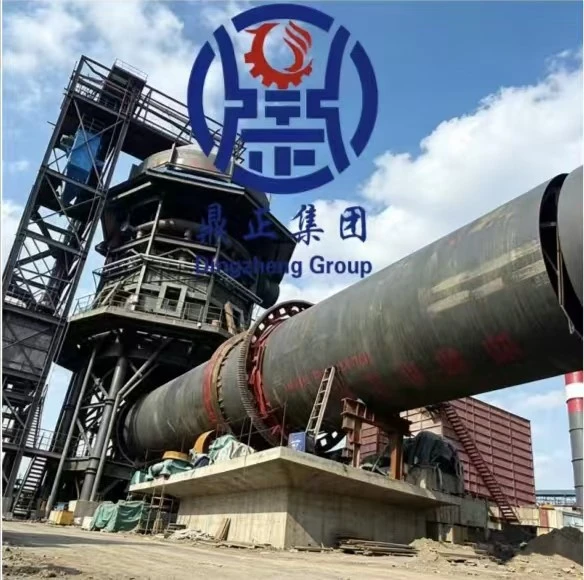
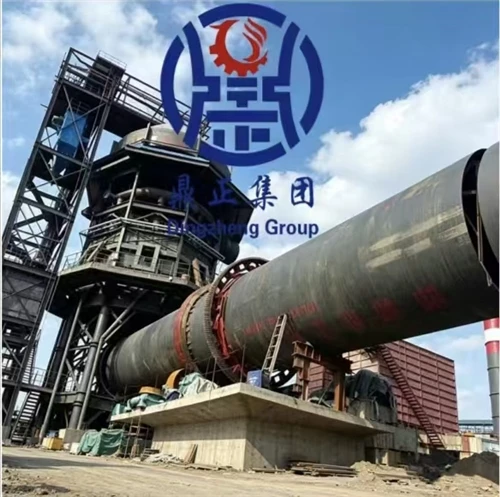
The primary structure of a lime rotary kiln consists of an elongated cylindrical shell designed with a minor gradient. Manufactured from high-strength steel, the shell is lined with heat-resistant refractory materials on the inner wall and firmly mounted on a set of support roller assemblies. Driven by the transmission system, the kiln runs smoothly at a low rotational speed, normally ranging from 1 to 4 rotations per minute. Equipped with a complete set of auxiliary equipment including preheaters, cooling devices, industrial burners and dust collectors, the whole unit forms a fully automatic, uninterrupted lime calcination production line.
The kiln's operation adheres to the core working theory of reverse-flow heat exchange and staged high-temperature calcination, and its entire production workflow is split into three key stages:
Feeding and Preheating Stage
Limestone raw materials are transported into the preheater via the automatic feeding device. Combined with the kiln's rotating motion and gravitational pull, the materials slowly migrate toward the lower kiln head end. Meanwhile, multiple fuel types such as pulverized coal and natural gas are injected and ignited at the kiln head, generating high-temperature flue gas that flows along the kiln axis from the head to the tail. Counter-flow contact between flue gas and moving materials achieves primary heat exchange, which eliminates moisture from raw materials and completes preheating preparation for limestone thermal decomposition.
Calcination and Decomposition Stage
When raw materials travel to the middle high-temperature section of the kiln with a temperature range of 1200–1400°C, continuous overturning and mixing enables full contact with high-temperature flue gas. In this extreme thermal environment, calcium carbonate (CaCO₃) undergoes complete pyrolysis reaction, producing finished quicklime (CaO) and carbon dioxide (CO₂). The persistent tumbling of materials ensures uniform heating throughout the calcination process, thoroughly avoiding partial under-burning and over-burning defects. This unique operating mode fundamentally ensures the stable and consistent quality of final lime products.
Cooling and Discharging Stage
After completing high-temperature calcination, the qualified quicklime is conveyed to the matched cooler for forced air cooling. Ambient cold air pumped into the cooler absorbs waste heat from high-temperature lime and turns into hot air, part of which is circulated back to the kiln head as combustion-supporting air to realize waste heat recycling and reduce energy consumption. Ultimately, the waste flue gas exhausted from the kiln tail undergoes comprehensive environmental treatment including dust removal, desulfurization and denitrification, meeting official emission standards before being discharged into the atmosphere.